Showing posts with label inspire. Show all posts

Saturday, 21 March 2026

What the Minoans Can Teach Us About Feminism

Even in later historical periods, women in Crete were known to enjoy more autonomy than their counterparts in mainland Ancient Greece. While Athenian women lived largely confined to the domestic sphere, Cretan women appear to have moved more freely within society, participating in public and possibly economic life (Pomeroy, 1994; Blundell, 1995).

So where does this difference come from?

To understand it, we have to go much further back, to the world of the Minoan Civilization.

A Different Kind of Society

Unlike the later, more rigidly patriarchal structures of mainland Greece, Minoan society presents a different archaeological picture. At sites like Knossos, there is little clear evidence of dominant male rulers in the way seen in later Mycenaean or Classical contexts. There are no unequivocal royal tombs celebrating individual kings, and even the figure of King Minos remains closer to legend than to confirmed political reality (Driessen & Macdonald, 1997; Schoep, 2010).

Instead, what emerges is a society that may have been less overtly hierarchical and more centred on collective or ceremonial forms of power.


This aligns with a broader anthropological argument that some earlier societies, particularly those less dominated by warfare and rigid class systems, may have operated with more balance between men and women. Roles may have differed, but were not always strictly ranked in terms of power or value (Ehrenberg, 1989; Marinatos, 1993).

Women at the Centre

Minoan art provides some of the most compelling evidence. Frescoes consistently depict women as active participants in public and ritual life. They are shown leading ceremonies, engaging in religious practices, and even taking part in activities such as bull-leaping.

They are not marginal figures. They are central.

Such repeated visual emphasis suggests that women held a visible and possibly significant role within Minoan society, especially when compared to the more restricted roles of women in later Greek contexts (Rehak, 1999; Younger, 2000).

The Sacred Feminine

Religion offers another important perspective. Female deities and priestly figures appear prominently in Minoan iconography. Figurines often interpreted as goddesses or priestesses, including the well-known snake goddess figures, suggest that spiritual authority may have been closely associated with women (Marinatos, 1993).


In many societies, the prominence of female divinity correlates with a broader cultural recognition of women’s symbolic or social importance. While this does not necessarily indicate equality in a modern sense, it does point to a different configuration of gender and power.

Luxury Without Kings

Another intriguing aspect of Minoan society is the distribution of material wealth. Luxury goods such as fine pottery, jewellery, and crafted objects are found across a range of contexts, but are not clearly tied to individual rulers or elite male burials.

This has led some scholars to suggest that wealth may not have been concentrated in the hands of a single ruling class, but instead functioned within communal or ceremonial systems, possibly mediated through religious institutions (Schoep, 2010).


Such a structure would again point to a society where power was expressed less through individual accumulation and more through shared or symbolic forms.

Was This a Feminist Society?

It is important not to project modern concepts directly onto the past. The Minoan Civilization was not “feminist” in the contemporary sense, and there is no evidence of formal structures advocating gender equality.

However, the archaeological and visual record suggests a society in which women were visible, active, and symbolically significant. Power does not appear to have been as exclusively male-dominated as in later Greek societies, and social roles may have been more balanced than strictly hierarchical.

Why It Still Matters

Examining the Minoan Civilization challenges the assumption that patriarchy has always been the dominant structure of human societies.

Instead, it suggests that what we see in later historical periods may represent a shift rather than a constant. If earlier societies could organise themselves in ways that allowed for greater visibility and participation of women, then alternative social models are not only possible, but have existed before.


References

Blundell, S. (1995). Women in Ancient Greece. Harvard University Press.
Driessen, J., & Macdonald, C. F. (1997). The Troubled Island: Minoan Crete Before and After the Santorini Eruption. Aegaeum.
Ehrenberg, M. (1989). Women in Prehistory. University of Oklahoma Press.
Marinatos, N. (1993). Minoan Religion: Ritual, Image, and Symbol. University of South Carolina Press.
Pomeroy, S. B. (1994). Goddesses, Whores, Wives, and Slaves. Schocken Books.
Rehak, P. (1999). “The Aegean Landscape and the Body: A New Interpretation of the Minoan Body.” American Journal of Archaeology.
Schoep, I. (2010). “The Minoan Palaces: Architectural Context and Social Function.” In The Cambridge Companion to the Aegean Bronze Age.
Younger, J. G. (2000). “Gender and Sexuality in Minoan Society.” In Aegaeum.

Saturday, 7 March 2026

March’s Secret Bracelet: From Martaki to the Mysteries of Eleusis

Martaki. Or Μαρτάκι. The tiny bracelet with the red and white thread that suddenly appears on wrists in March like some secret Balkan coding system.


In Greece, it’s worn from March 1st to protect from the strong spring sun — especially the first sun of the year, which folk tradition says can “mark” the skin. At the end of the month, or when you see the first swallow, you take it off and tie it to a tree so the birds can use it for their nests. Which is either adorable ecological symbolism or ancient bio-magic. Possibly both.

Now let’s time-travel.

The custom is widely believed to trace back to the Eleusinian Mysteries, the secret initiation rituals for Demeter and Persephone in ancient Greece. Participants supposedly tied a thread — called a krokē — around their right wrist and left ankle during the rites. That detail comes from references in ancient sources like Clement of Alexandria, who mentions it while criticizing pagan practices. (Christians were very good at accidentally preserving pagan details while trying to condemn them.)

The timing is interesting. March in the ancient Greek calendar was tied to the month of Elaphebolion — around the time of the spring equinox. This is Persephone-returning-from-the-underworld season. The land waking up. Agricultural rebirth. Transition from winter scarcity to spring light.

Red and white are not random.

  • White = purity, light, maybe Demeter.
  • Red = life, blood, protection, maybe Persephone.
Or more broadly: winter (white) braided with life force (red). Death and return. Descent and ascent. You see the mythic symmetry.

There are similar traditions in Bulgaria (Martenitsa) and Romania — which tells us something important: this is older than modern nation-states. Likely a deep Balkan seasonal rite, possibly pre-classical in origin, later absorbed into Greek folk Christianity. Folk practices are stubborn survivors. They flow under official religion like groundwater.

Friday, 4 March 2016

Sunday, 21 February 2016

My art: the imaginary Poppy World

Final work

 This is one of my artworks. This was the final product of a long process that was composed of loads of little steps. See below. My intention was to show the imaginary poppy world full of my memories, fears, delusions a bit like a snapshot to my subconscious.

Attempt before the final

Taking and manipulating photos

Weaving a blanket of memories (1)

Weaving a blanket of memories (2)

Weaving a blanket of memories (3)

Weaving a blanket of memories (4)

Weaving a blanket of memories (5)

Weaving a blanket of memories (6)

Thursday, 18 February 2016

My art: Holiday in Cambodia


Some of my artwork inspired from my trip to Cambodia in 2007. The purpose of the project was to show places/people as they were carved in my memory as opposed to how they looked on the photos. Through this project I wanted to show my feelings when being in certain places as I later recalled them.  Sometimes photos strip the emotion out of them by showing reality as it is/was as opposed to how it felt.  

Thursday, 11 February 2016

Alan Watts ... on money

You will find me quoting Alan Watts a lot. Here is a good one about money!

Thursday, 26 April 2012

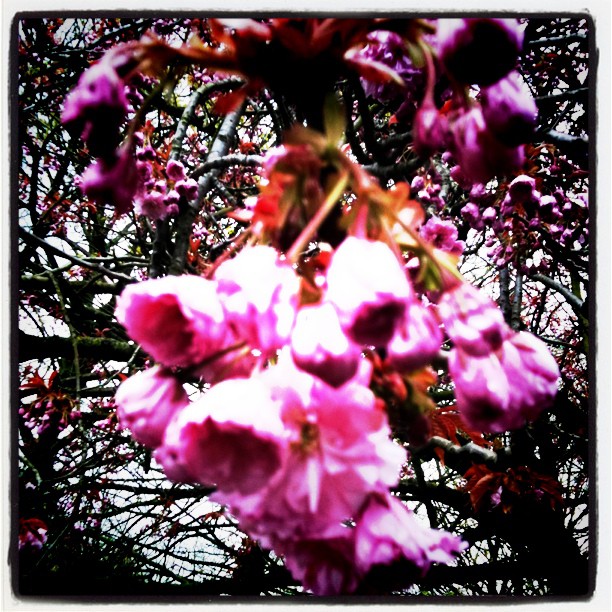
Pink Tree

There are so many blossoms in the UK at the moment it is absolutely the best time of the year!

Today we went walking and we saw this really wonderful tree with beautiful pink flowers! For me this tree is the best time in spring. Well it'd be nicer if it did not rain today, but you cannot have it all!
This beautiful tree is a weeping Japanese cherry tree whose main use is ornamental.

This is really good inspiration for my cherry tree stencil for my wardrobe!
Prunus Kiku shidare Zakura or Japanese Cherry
Japanese Cherry blossom


Wednesday, 25 April 2012

Roses from Greece

My mum came over and she brought some really nice roses from our garden in Greece. How i miss home sometimes! Enjoy the Greek roses.
Greek roses
Greek Roses

Monday, 23 April 2012

Bluebells


Late April, early May is the best part of the year in the North of England as this is the time the bluebells come out. A bluebell or Hyacinthoides non-scripta is particularly associated with ancient woodland where it may dominate the understorey to produce carpets of violet–blue flowers in "bluebell woods". We went for a walk the other day hoping to get a glimpse of this wonderful plant and here's some nice photos!

bluebell woods
Bluebell woods

cluster of bluebells
Amazing clusters of blue magic
Hyacinthoides non-scripta
Hyacinthoides non-scripta (Bluebells)

bluebells
A close up of bluebells

I hope you enjoy them until next year!


Sunday, 17 October 2010

Northumberland


Last Friday: on the way to Northumberland